Lens: Olympus 38 mm f/2.8 auto bellows lens
Vintage: 1980 - ??
Lens Mount: Olympus OM mount
Needed Adapters: To make this lens work on a non-Olympus lens mount, you will need a couple different adapters. First, I use an OM to 4/3 adapter. That will allow one to use an OM lens on new Olympus 4/3 mount dSLR's. Second, I use cheap (5-piece) extension tubes from eBay. These have screw-on lens mounts on the front and back. If you buy one for a 4/3 mount and one for your camera's lens mount, you can take the female 4/3 mount and screw that to the male lens mount for your camera. hook them all together and you are ready to go. The only problem is that some of the cheap extensions have the opposite threading and you may end up both pieces having a male thread. I would suggest that you buy them from the same supplier (and keep your fingers crossed). If that happens, all is not lost. I have found a 57mm step-down ring that will fit into the female adapter and that can be adapted to a reversing ring (I had to do this to make a Minolta adapter, so I know it works).
Preferred Mounting: Normal, not reversed
Filter Thread: 49 mm, but recessed from the front of the lens and only useful for mounting the lens cap.
Street Price: $300-$700 in good used condition. Prices vary a lot online, shop around.
Controls: This lens has two controls - aperture setting and an a focus ring that allows you to adjust the extension for fine adjustment of focus. This lens has the capability of having automatic aperture control with an Olympus body, although it loses that ability when adapted to other lens mounts.
Aperture: 6 blades.
Basic Function: Requires a bellows for setting focus and magnification. Fine focus can be had with the focus/extension ring on this lens.
| Extension | Magnification | Working Distance |
| adapters | 2.03 | 56 mm |
| 25 mm | 2.74 | 41 mm |
| 5 cm | 3.19 | 39 mm |
| 9 cm | 4.21 | 36 mm |
| 13 cm | 5.24 | 34 mm |
| 19 cm | 6.94 | 33 mm |
| Est. Focal Length: 37.7 mm | ||
Appearance:


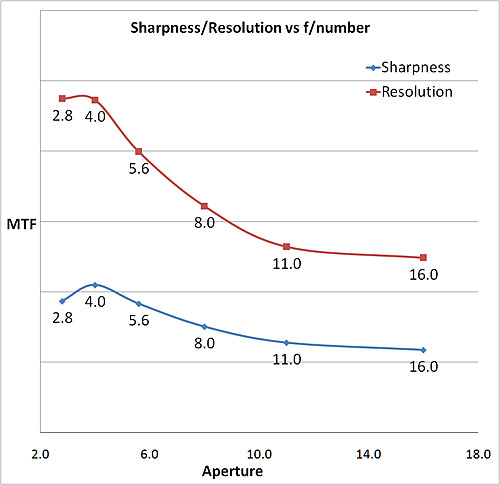 Resolution vs. Aperture:
This lens is at its sharpest at f/4. For the focal length and expected magnification range, The relatively large sharpest aperture will provide sharp and detailed images.
The most detailed aperture is f/2.8 although the resolution is only minimally greater than that at f/4. I don't see any real advantage of using f/2.8 because of this.
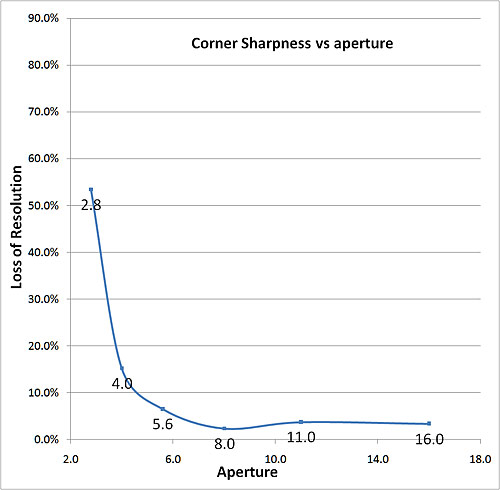 Corner Sharpness vs. Aperture:
There is a moderate amount of peripheral fuzziness seen at f/2.8. At all apertures above this, the field is commendably flat, about 15% at f/4 and less than 10% above that.
This testing was performed in the worst case scenario at the lowest magnification I can make with this lens, about 2:1. These numbers will tend to improve for all apertures as the magnification increases.
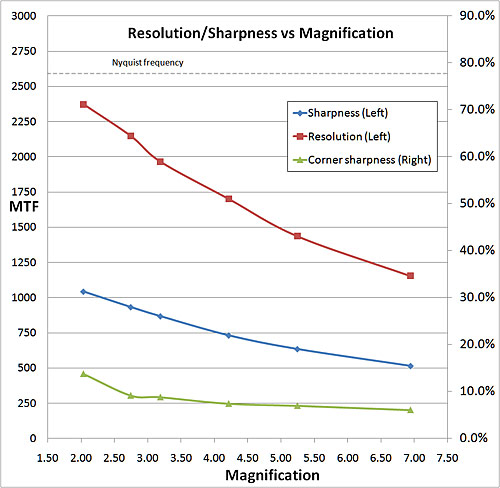 Sharpness and Resolution vs. Magnification:
This lens produces very sharp and detailed images from a magnification of 2:1 to 7:1. At 2:1 there are very few lenses that outperform this lens and those that do, only by a relatively small margin.
At 7:1, this lens will resolve details down to about 2 um at the higher end of its magnification range. This is good, but can be outdone by shorter focal length bellows lenses and microscope objectives. The increase in resolution with these other lenses will come at the expense of shorter working distance.
The corner sharpness is extremely good across the usable magnification range.
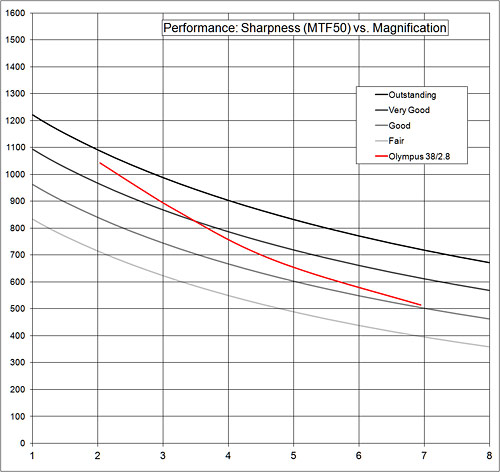 Performance: Sharpness vs. Magnification:
I have 4 lines that represent levels of performance from outstanding (top) to fair (bottom). This shows where this lens fits into the hierarchy that I have created.
The Olympus 38mm shows sharpness performance that varies from very good at the low-end to good at the high-end of its magnification range.
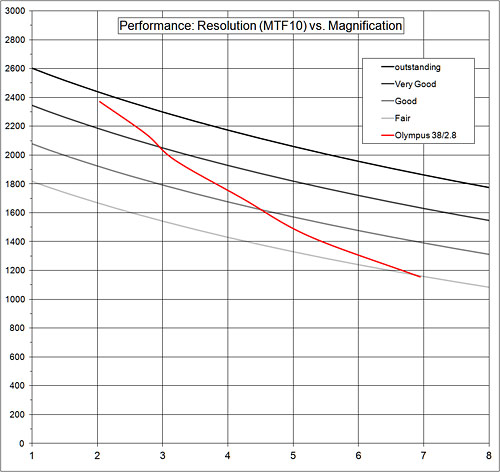 Performance: Resolution vs. Magnification:
I have 4 lines that represent levels of performance from outstanding (top) to fair (bottom). This shows where this lens fits into the hierarchy that I have created.
The Olympus 38mm shows resolution performance that varies from very good at the low-end to fair/poor at the high-end of its magnification range.
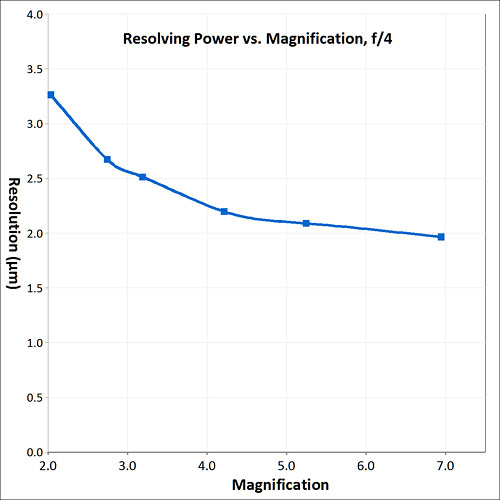 Resolving Power vs. Magnification:
This graph represents the smallest details that are able to be resolved by this lens at various magnificaitons. If the number doesn't get smaller as the magnification rises, there is little benefit to going up in magnificaiton with this lens. This situation is also called empty magnification.
Good resolution, improvements tail off above 5:1.
Chromatic Aberration: This lens shows minimal color fringing in the center (about 0.30 - 0.60 pixels) and mild in the periphery (0.20 - 1.2 pixels). On the periphery, it stays below 1 pixel at all but the highest magnification. Anything below 1.0 pixel is good and only minimally visible.
Image Contrast: Image contrast is very good, typical for high-quality bellows lenses.
Flare: This lens shows no significant flare during testing.
Distortion: This lens shows no significant distortion during testing.
Image Samples:
About 2:1 magnification, f/4, focus stack of 18 images, resized:

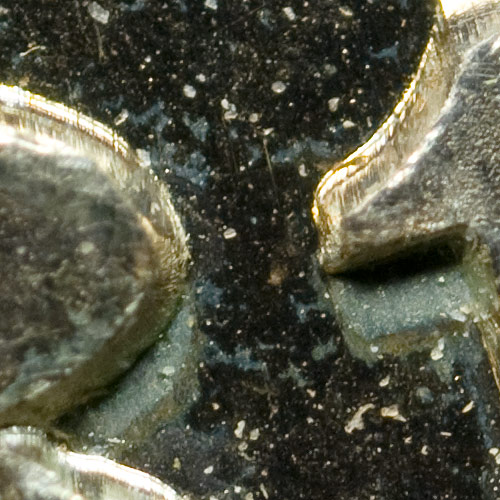 Pixel level crop from the image above:
There is very good pixel level detail, no problems.
About 5:1 magnification, f/4, stack of 24 images, resized:

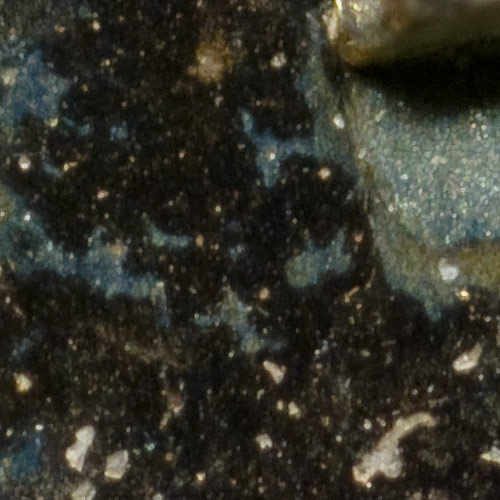 Pixel level crop from the image above:
Good detail but starting to show the effects of diffraction.
Conclusion:
This is a bellows lens that performs well from 2:1 to about 7:1. Its combination of high resolution, flat field, and relative lack of chromatic aberration make it hard to find a lens that will outperform it in the lower magnification range. In the higher magnification range, you will have to go to shorter focal length bellows lenses or microscope objectives to significantly outperform it ( at the expense of less working distance).
It is a strong all-around performer that I highly recommend. It is also commonly available on the internet (used camera stores and eBay). The only problem that I can see is that it can be a little tough adapting this lens to other lens mounts, but one that is not insurmountable with the right equipment.