Lens: Nikon micro-Nikkor 105/2.8 VR
Vintage: Current.
Lens Mount: Nikon F-Mount.
Needed Adapters: None.
Preferred Mounting: Normal, not reversed.
Filter Thread: 62 mm.
Street Price: About $900 new.
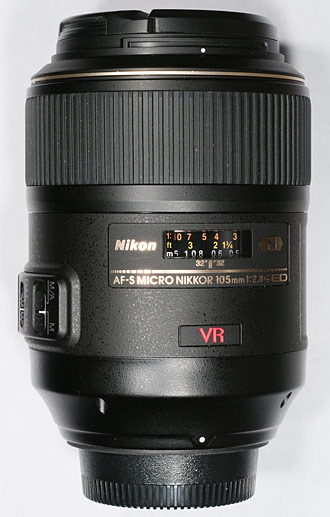
Controls: The lens has several controls including a focus ring, VR on/off, focus limiter, manual vs autofocus. It is a G-series lens and doesn't have an aperture ring. The lack of an aperture ring limits its use on a bellows and for reverse mounting. If you want to use an extension ring it will need to have all of the electrical and mechanical connections to work properly (current Kenko tubes seem to work OK).
I really like the easy to move focus ring on this lens. The light action allows for very easy setting of focus with a high degree of fine control. Compare this lens to the 200/4 AF micro and you will see a huge difference. I love the 200/4 micro, but the focus ring on it is very stiff.
Aperture: 9 blades, nearly circular across all aperture settings.
Basic Function: Internal focus macro lens, no change in length with focusing.
| Focus | Magnification | Working Distance |
| marked 0.25:1 | 0.25 | 447 mm |
| marked 0.50:1 | 0.50 | 241 mm |
| about 0.75:1 | 0.77 | 178 mm |
| marked 1:1 | 1.00 | 153 mm |
Appearance:

 Resolution vs. Aperture:
This lens displays effective aperture in the viewfinder - the aperture adjusted for magnification. This makes testing for a specific aperture more difficult as the aperture numbers change as the focus is changed. I tested at the maximum magnification of just over 1:1. that means that the aperture listed on the graph are twice the normal aperture setting.
This lens is sharpest at an effective aperture of f/13 - roughly equivalent to the typical setting of f/6.7. To get the sharpest pictures at 1:4 magnification you will need to set the aperture to about f/8, f/10 at 1:2, and f/13 at 1:1.
Ths highest resolution is seen at an effective aperture of between f/8 and f/10 (or f/4 to f/5).
 Corner Sharpness vs. Aperture:
This lens shows atypical behavior in the corner sharpness (as far as my experience goes). I believe that this is related to the complexity of the design and internal moving elements.
I found that it shows very sharp edges when wide open - good for focusing the lens. As the aperture is closed down the corner sharpness decreases and is worst in the f/11 to f/16 range (coincidently the sharpest apertures for the center of the field). Even though the loss of sharpness in the corners measures around 30% in this region, the pictures really look pretty good. There is very little fuzziness on the edges in real-world imaging.
I think that with a internal focus design and the fact that lenses are moving around in relation to each other when the focus is changed, compromises will have to be made in the design. You can't correct for all aberrations at all focus points.
The edges do sharpen up as the magnification is decreased and is quite good through most of the normal macro range (see next section).
 Sharpness and Resolution vs. Magnification:
This lens shows good resolution and sharpness throughout the normal macro range. the MTF50 is about 1060 lw/ph at 1:1. Anything above 1000 is good at 1:1 and anything above 1200 lw/ph is stellar (see Pentax 100mm bellows lens for comparison). Shorter focal length lenses will tend to have slightly better numbers, but that is the price you pay for extra working distance of a long focal length lens.
The resolution numbers are very good across the macro magnification range and either out-resolves or is very close to out-resolving the detector throughout (Nikon D200 detector). You will not lack for image detail with this lens.
I added a third line to the graph showing edge sharpness vs. magnification (at f/13) to show that the edge sharpness is very good at magnifications lower than 1:1.
What makes the edge sharpness atypical is that it worsens with increasing magnification. Lenses that block focus (all of the lenses move as a unit away from the detector) tend to show better corner sharpness as the magnification rises.
 Performance: Sharpness vs. Magnification:
I have 4 lines that represent levels of performance from outstanding (top) to fair (bottom). This shows where this lens fits into the hierarchy that I have created.
The Nikon 105VR shows sharpness performance that varies from outstanding at the low-end to good at the high-end of its macro magnification range.
 Performance: Resolution vs. Magnification:
I have 4 lines that represent levels of performance from outstanding (top) to fair (bottom). This shows where this lens fits into the hierarchy that I have created.
The Nikon 105VR shows very good resolution performance across the macro magnification range.
 Resolving Power vs. Magnification:
This graph represents the smallest details that are able to be resolved by this lens at various magnificaitons. If the number doesn't get smaller as the magnification rises, there is little benefit to going up in magnificaiton with this lens. This situation is also called empty magnification.
Very good resolution, no problems.
Chromatic Aberration:
This lens show minimal color fringing in the center of the field and moderate fringing (1-2 pixels) on the periphery - worsens with increasing magnification. This fringing will be visible on the edges of images in certain high-contrast situations. JPG's produced by the camera will commonly correct for some of this color fringing. It can also be corrected in post-processing to a certain extent.
Image Contrast: Image contrast is very good, typical for high-quality macro lenses.
Flare: This lens shows no significant flare during testing.
Distortion: This lens shows no significant distortion during testing.
Image Samples:
About 1:3 magnification, f/13, cropped and resized:

 Pixel level crop from the image above:
There is very good pixel level detail, no problems.
About 1:1 magnification, f/13, resized:

 Pixel level crop from the image above:
There is good pixel level detail, no problems.
Conclusion:
This is a macro lens that performs very well in the macro range of magnification. There is very little to complain about except for a little corner unsharpness at higher magnification (not particularly visible) and moderate color-fringing (typically at least partially correctable). I have not noticed either during the typical coin macro photography that I perform. I use this lens a lot for my coin photography (Probably my #2 lens. I use my 85 PC micro most).
The internal focus design is helpful in that the lens doesn't extend toward the subject as the focus is set (important for bug photos, not so much for coins). The longer focal length makes this an ideal lens for coin photography. Good working distance allowing for good lighting, but not so much that you need a really tall copy stand.
The f/2.8 maximum aperture also makes for a bright viewfinder and easy focusing when doing macro work.