Lens: Cheap 4x/0.10 achromat microscope objective
Vintage: Current
Lens Mount: RMS
Needed Adapters: RMS to T-mount adapter, T-mount to nikon Adapter, easily found on eBay.
Preferred Mounting: Normal, not reversed.
Filter Thread: None.
Street Price: $20-$35 new.
Controls: None
Aperture: Aperture is fixed at a numerical aperture of 0.10 (roughly equivalent to f/4 on a typical lens)
Basic Function: Requires a bellows to set focus and magnification
| Extension | Magnification | Working Distance |
| 9 cm | 4.25 | 28 mm |
| 13 cm | 5.54 | 26 mm |
| 16 cm | 6.54 | 25 mm |
| 19 cm | 7.54 | 24 mm |
| Est. Focal Length: 30.4 mm | ||
Appearance:


 Corner Sharpness vs. Magnification:
This objective shows very fuzzy corners. This is what you get with a cheap achromatic objective. These are made to be sharp in the center. To keep the designs cheap and simple they forego the corner sharpness. If you want sharper corners, get a planar objective (called "plan"). They will tend to cost a little more.
I wouldn't recommend going much below 4:1 magnification with this objective as the corner performance just worsens more.
 Sharpness and Resolution vs. Magnification:
Despite the inexpensive nature of this objective, the central sharpness and resolution is actually pretty good. It will resolve details down to about 1.7 um at 7:5:1 magnification.
 Performance: Sharpness vs. Magnification:
I have 4 lines that represent levels of performance from outstanding (top) to fair (bottom). This shows where this lens fits into the hierarchy that I have created.
The cheap 4x achromat shows very good to good sharpness performance across its magnification range.
 Performance: Resolution vs. Magnification:
I have 4 lines that represent levels of performance from outstanding (top) to fair (bottom). This shows where this lens fits into the hierarchy that I have created.
The cheap 4x achromat shows good to fair resolution performance across its magnification range.
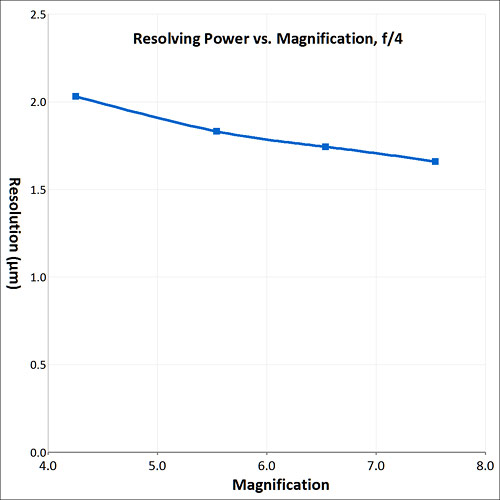 Resolving Power vs. Magnification:
This graph represents the smallest details that are able to be resolved by this lens at various magnificaitons. If the number doesn't get smaller as the magnification rises, there is little benefit to going up in magnificaiton with this lens. This situation is also called empty magnification.
Good resolution, compatible with an f/4 lens.
Chromatic Aberration: This lens show minimal color fringing in the center (about 0.10 - 0.25 pixels) and mild on the periphery (0.7- 1.1 pixels). Color fringes are another factor that microscope objectives tend to have depending upon the price of the objective. The most expensive, apochromatic objectives have the least, while the least expensive tend to have quite a lot. This objective actually does pretty well for its price.
Image Contrast: Image contrast is good for this magnification range, but less than its more expensive name-brand bretheren.
Flare: This lens shows significant flare when used with reflected light owing to the reflective inner surface of the cap that goes on the end of the objective. This flare can be be easily remedied by just unscrewing the cap. (see picture above)
Image Samples:
About 4.2:1 magnification, f/4, focus stack of 33 images, resized: The corner performance on this focus stacked image is actually better than you would expect by the poor corner performance. This improvement is related to the fact that the lens has significant field curvature. Field curvature is where the plane of sharp focus is not flat (while the detector is). This can be corrected with a more expensive design. This aberration can be seen in images fairly easily. If the center is in focus, the edges won't be. If the edges are in decent focus, the center won't be. A single image will always look bad. A focus stacked image will help to compensate for the field curvature (as in the image below).

 Pixel level crop from the image above:
There is very good pixel level detail in the center of the image.
About x:1 magnification, f/x, stack of x images, resized:

 Pixel level crop from the image above:
There is good pixel level detail, no problems.
Conclusion:
This is an objective that works reasonably well as a bellows lens. The sharpness and resolution are quite good for the objective magnification range of about 4:1 to 8:1. The corner performance is where the cost cutting is done for this objective. With a single image, the corners are very fuzzy. The situation improves quite a bit when you use focus stacking to make images. The inherent field curvature of this lens can be compensated for by the focus stacking process and the corners actually look decent when done. This lens also lacks a bit in image contrast compared to more expensive objectives, but the images look OK. The color correction is actually pretty good for this lens and it doesn't show large fringes in the center or on the periphery. This lens does suffer from significant flare although that can mostly fixed by removing the cap on the end of the objective. You could also put flocking on the inside of the cap and leave it on.
Its low price is tempting, but you will likely be better served by finding a planar objective for a few dollars more.